Published by RC Publications, Inc., Summer 1996. Format: Perfect-bound magazine, 10.75 by 9 inches, 196 pages.
EDITOR’S NOTE
At this year’s Sundance Festival, it was hard not to notice the welcome preponderance of films created by women, or featuring substantial roles for female characters, or both. Our second annual Sundance Issue reflects that situation, containing three screenplays—Bound, Walking and Talking and Girls Town—which take female relationships as their theme. Each might be said to offer an independent alternative to the overworked male “buddy movie” formula that studios have offered filmgoers for decades. And, while the three scripts’ thematic similarities might suggest a lack of variety in this issue, that is hardly the case: the screenplays in question vary markedly in terms of subject matter, genre, sensibility and execution. Bound is a hyper-stylized neo–film noir; Walking and Talking is a deftly observed Manhattan comedy; and Girls Town is a gritty, politically informed film with the look and feel of a documentary.
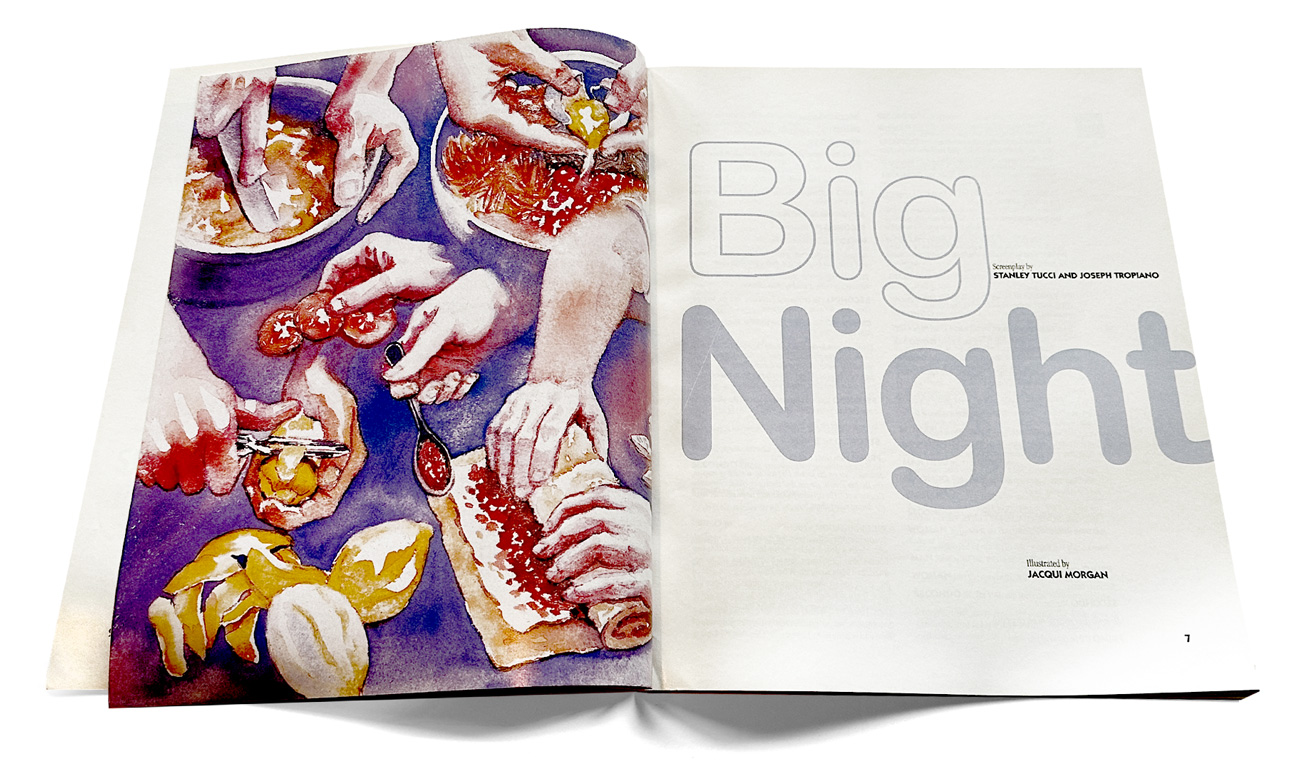
Our lead-off screenplay-winner of the Waldo Salt Award for Screenwriting at this year’s festival is Big Night, written by Stanley Tucci and Joseph Tropiano. This meticulously crafted work tells the story of two brothers, Primo and Secondo, who are Italian emigres trying to succeed as restaurateurs in an American seaside resort in the ’50s. Primo, a true culinary artist and resolute idealist—won’t compromise his cooking to appeal to the spaghetti-and-meatballs tastes of the local populace; Secondo, faced with a bank foreclosure, is convinced that such a compromise is their only ticket to survival. When a neighboring restaurant owner offers to arrange for recording star Louis Prima and his band to dine at the restaurant, the two brothers risk everything to make the evening memorable. Big Night delineates the uneasy marriage—well-known to any screenwriter—of art and commerce, while offering an alternative to the stereotypical film image of Italian-Americans as gun-toting mobsters. Tucci and Tropiano discuss their discomfort with such portrayals, while also relating why many of the scenes from the shooting script featured here were cut from the final film.
Bound, a genre- and gender-bending script by brothers Larry and Andy Wachowski, follows. Corky, a tough ex-con, and Violet, a sultry gangster’s moll, fall in love and decide to pull a fast one on Violet's live-in boyfriend, Ceasar, involving the “disappearance” of over $2 million in cash. Ceasar’s affiliation with the Mafia guarantees high stakes for the two women’s success. A polished, self-assured send-up of classic film-noir clichés, the script crackles with pungent dialogue and careens through innumerable plot twists, all the while confirming Violet’s assertion that “You can’t believe…what you see, but you can believe what you feel.” The Wachowski brothers talk about their initial reasons for wanting to write a film with two strong, sympathetic—not to mention triumphant—female protagonists, as well as their travails in finding the right actresses to play them.
Nicole Holofcener’s Walking and Talking, an audience favorite in the festival’s dramatic competition, treats the subjects of marriage and friendship with wit, insight and economy. It centers on the story of best friends Amelia and Laura, whose relationship is jeopardized when Laura informs Amelia—currently, and desperately, single—of her imminent wedding. Much of the film’s strength comes from its keen observation of the often ridiculous lengths to which people go when faced with either the prospect of aloneness, or, conversely, the comforts of lifelong companionship. Holofcener describes the efforts (spanning six years and “30 to 40” rewrites) involved in getting her script produced, and reveals how similar events in her own life provided the film’s dramatic core. She also goes into detail about the value of her experiences at the Sundance Institute Writers and Filmmakers Labs, where she worked on the script during the rewrite process.
The recipient of both the Filmmakers Trophy and a Special Jury Award for Outstanding Collaborative Merit at this year's festival, Girls Town, written by Jim McKay (the film’s director) and Denise Casano, Bruklin Harris, Anna Grace and Lili Taylor, closes the issue. The product of an intensive improvisational process, this script concerns three teenage girls—Patti, Emma and Angela (played in the film by Taylor, Grace and Harris)—whose friend Nikki’s suicide forces them into an unprecedented solidarity. This allows them not only to “avenge” her death, but to develop an awareness and an ability to confront the injustices in their own lives. Both McKay and the three actors offer detailed accounts of the workshop process that led to the creation of the script, as well as discussing the improvisation that occurred during the film’s bare-bones, 15-day shooting schedule.
A brief note on a couple of changes in this issue: Due to its release date being pushed back to the end of 1996, Citizen Ruth—originally scheduled for this issue of Scenario—will instead appear in the next issue. And, although we had hoped to include here an interview with independent filmmaker Samuel Fuller, health problems necessitated postponing that interview until a later date.
The four screenplays which follow are a testament to the remarkable creativity—not to mention range—present in much of today’s independent cinema. We’re grateful to the filmmakers for their efforts, and to Sundance, as always, for devising and maintaining a structure—both through the festival and the Institute's Lab programs—to nurture and promote these singular visions.
By the way, you’ll notice an extra feature, “Funnel Vision,” midway through the issue, the first in what we hope will be a series of “invitationals” that will appear in these pages periodically. It contains the responses of five independent filmmakers who were asked by Scenario to “rewrite” the Hollywood blockbuster Twister. The results are, as you might expect, unique and irreverent—and decidedly independent. We’d be interested to hear your responses to them.—Tod Lippy
SCENARIO VOL. 2, NO. 3 CONTENTS
Editor's Note
By Tod Lippy
Sundance’s “Agenda”: A Talk with Geoffrey Gilmore
Big Night
Screenplay by Stanley Tucci and Josepth Tropiano
Writing & Directing Big Night
A Talk with Stanley Tucci
Bound
Screenplay by Larry and Andy Wachowski
Writing & Directing Bound
A Talk with Larry and Andy Wachowski
Funnel Vision: A Scenario Invitational
We asked Sundance alumni including Kevin Smith, Mary Harron, Michael Almereyda, and Tom DiCillo to "rewrite" the summer blockbuster Twister
Walking and Talking
Screenplay by Nicole Holofcener
Writing & Directing Walking and Talking
A Talk with Nicole Holofcener
Girls Town
Screenplay by Jim McKay and Denise Casano, Anna Grace, Bruklin Harris, Lili Taylor
Writing & Directing Girls Town
A Talk with Jim McKay
'Girls' Talk
Anna Grace, Bruklin Harris, and Lili Taylor discuss co-writing, and acting in Girls Town