Published by RC Publications, Inc., Fall 1996. Format: Perfect-bound magazine, 10.75 x 9 inches, 240 pages.
EDITOR’S NOTE
“Every thing in this world...is big with jest,—and has wit in it, and instruction too,—if we can but find it out.”—Laurence Sterne, Tristram Shandy
Where has all the satire gone? It's a question editor Lewis Lapham posed in a recent issue of Harper’s magazine, where he meditated upon the diminished presence of this venerable literary genre in contemporary America. In his estimation, the country that honed the sharp, cathartic wit of H. L. Mencken, Mark Twain, Ambrose Bierce and the Algonquin Round Table regulars—to name only a few—“appears to have lost its appetite for objection and dissent.” What unfortunate timing: the satirist’s agenda—to not only denounce and ridicule deserving targets, but also awaken an audience’s critical response to them—has never seemed more necessary.
Happily, this genre is well-represented in the current issue, which features two screenplays—Citizen Ruth and The Dreyfus Affair—that coerce the humor out of their essentially serious subjects with the same relentlessness that informs all worthwhile satirical efforts. Each script takes aim at an issue that has been obscured by fear, piety and dogma, exposing the hypocrisies and hidden agendas related to it by presenting them to us on their own, often absurd, terms.
Citizen Ruth, written by Alexander Payne and Jim Taylor, tackles perhaps the most incendiary political issue of our time: the abortion debate. Rather than present a case for one side or the other, it gives us a protagonist, Ruth Stoops—a down-and-out drug addict who finds herself pregnant, again—whose experiences with both pro-life and pro-choice activists make clear the indifference of both sides to her well-being. The script, filled with the kind of shrewd observations that inform the films of Buñuel, is merciless with every one of its characters, including Ruth. Yet each character is left with his or her humanity intact, because Payne and Taylor’s ultimate target is the spiraling extremism the issue has inspired. The writers talk at length about the challenges of writing an appealing main character whose flaws far outnumber her virtues, as well as explaining why a number of scenes in this draft, including two extraordinary dream sequences, weren’t used in the film.
Peter Lefcourt’s The Dreyfus Affair sets its sights on another hot-button topic: homophobia in the sports world. Adapted from Lefcourt’s well-regarded 1992 novel, the script tells the story of Randy Dreyfus, superstar shortstop for the Los Angeles Valley Vikings, who happens to fall in love with his second baseman, DJ Pickett. The title of the screenplay refers back to “l’affaire Dreyfus” in France of the 1890s, in which a high-ranking Jewish military officer was unjustly accused of, and sent to prison for, high treason. Lefcourt draws convincing parallels between the simmering anti-Semitism in the French military at the time and the anti-gay bias of present-day organized baseball. Perhaps Lefcourt’s greatest achievement is that, despite its satirical bite, The Dreyfus Affair also works as a straightforward, even warmhearted, romantic comedy. Lefcourt goes into detail about the choices he made during the adaptation process, as well as recounting the impressive list of studios, producers, directors and actors who have expressed interest in the script along the way.
Our lead-off screenplay, Tin Cup, was written by John Norville and Ron Shelton, and introduces us to Roy”Tin Cup” McAvoy, a driving-range pro from sleepy Salome, Texas, whose love for the town’s new (and only) psychologist, Molly, inspires him to attempt to win the U.S. Open. Like Shelton's other films, Tin Cup is more than just a love story: it’’s a nuanced reflection on the essential, and beautiful, mystery of relationships between the sexes played against the rites and rituals of competitive sports. And, as usual, it’s full of characters we’re grateful to spend time with, such as Tin Cup himself, whose desire to “go for it”—an amalgam of personal philosophy, chutzpah and sheer stubbornness—leads him to a “victory” he can truly call his own. Both Shelton and Norville—who wrote the spec script and has collaborated with the director on several other projects—relate their initial reasons for writing the screenplay, and discuss how the characters (particularly Molly and Doreen) changed significantly over several drafts to better serve the story.
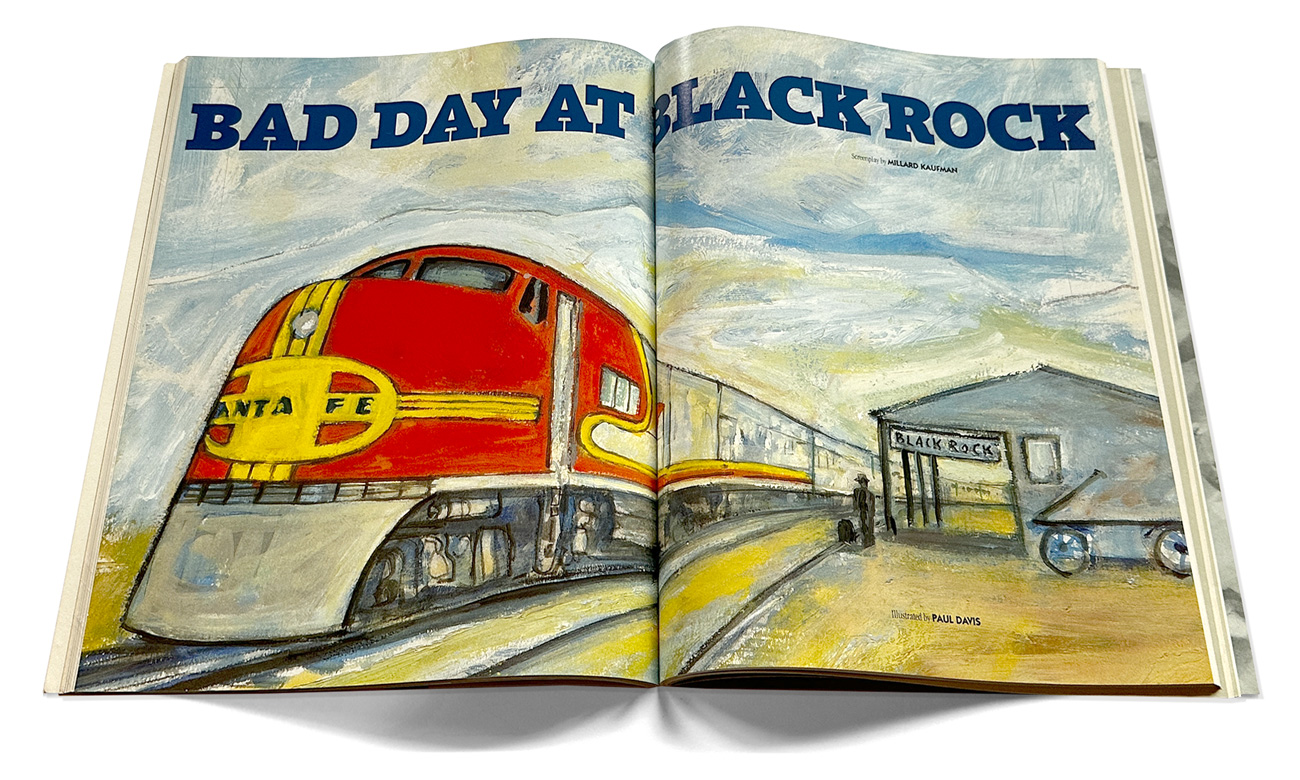
Bad Day at Black Rock garnered writer Millard Kaufman an Academy Award Nomination in 1955; it has since entered the canon of American film classics. World War II veteran John J. Macreedy has come to Black Rock on a mission—to present the medal of honor that has been posthumously awarded to Joe Komoko, his fellow soldier and friend, to Komoko’s father. Yet all he finds upon his arrival are the charred remains of the father’s house, a mysterious patch of wildflowers, and a town populated by xenophobic, uncooperative bullies. As Macreedy assembles the pieces of the puzzle, he grows increasingly aware that these men had a role in the father’s disappearance, and that their plans for him are no less menacing. Written during the blacklist period in Hollywood, and crafted with a precision and economy that perfectly sustain the dramatic tension readers will remember from the film (directed by John Sturges), Bad Day is both message movie and timeless fable. Kaufman discusses his employment of classical dramaturgy in the writing of the screenplay, as well as his involvement in political issues at the time, sharing several anecdotes about Hollywood in the ’50s.
Finally, we are pleased to present the first winner of the Scenario/Writers Guild of America, East Foundation Student Screenplay Competition: Till Human Voices Wake Us, by Michael Petroni. This haunting tale of a boy who loses his childhood love—and innocence—only to be confronted with vestiges of both many years later, signals the introduction of a strong and original voice in screenwriting. It’s in good company.—Tod Lippy
SCENARIO VOL. 2, NO. 4 CONTENTS
Editor's Note
By Tod Lippy
Tin Cup
Screenplay by John Norville and Ron Shelton
Writing & Directing Tin Cup
A Talk with Ron Shelton and John Norville
Citizen Ruth
Screenplay by Alexander Payne and Jim Taylor
Writing & Directing Citizen Ruth
A Talk with Alexander Payne and Jim Taylor
The Dreyfus Affair
Screenplay by Peter Lefcourt
Writing The Dreyfus Affair
A Talk with Peter Lefcourt
Bad Day at Black Rock
Screenplay by Millard Kaufman
Writing Bad Day at Black Rock
A Talk with Millard Kaufman
Till Human Voices Wake Us
Screenplay by Michael Petroni
Michael Petroni on Writing Till Human Voices Wake Us