Published by RC Publications, Inc., Spring 1996. Format: Perfect-bound magazine, 10.75 by 9 inches, 208 pages.
EDITOR’S NOTE
It’s summer, and you know what that means: a steady stream of blockbuster films that are long on “action” (explosions, disasters, aliens) and, more often than not, short on just about everything else. I saw the first of these mega-films, Twister, several weeks ago, and, despite the intense hype surrounding the film (to which I had obviously succumbed), I left the theater feeling cheated—flying cows notwithstanding—by the film's skeletal, often nonsensical plot and two-dimensional characters.
You would probably tell me I’m naive to expect to find rich characterizations and solid story structure in a summer blockbuster whose raison d’être is its special effects. But why is this so unrealistic an expectation? (Remember Jaws?) Logically speaking, aren’t these the kind of films—flush with creative and financial capital as well as an almost guaranteed audience—that should at least make a stab at presenting a story with something other than a ludicrously formulaic (the “bad” scientists in Twister drive black vans) recipe?
If only one—just one—of the 53 compelling characters in John Sayles’s film, Lone Star, whose script opens this issue, could have lent his or her considerable dramatic presence to Twister or, for that matter, any of the other similarly anemic summer blockbusters. In his new, ambitious work, Sayles has once again managed to imbue both his major and minor characters with a remarkable depth and humanity. The film’s structure offers equal rewards with its story of Sam Deeds, the Sheriff of Frontera, a small border town in Texas, and his struggle to come to terms with the overwhelming influence of his father. But it would be short-changing Sayles’s accomplishment to describe the screenplay in such narrow terms: intertwining three distinct plots, it concerns itself with issues both broad (racism, tribalism, multiculturalism and border politics) and personal (particularly, love’s tenacity). After discussing his writing process in detail in the interview, Sayles relates how he separates the work for hire he does for major studio films from the writing—of screenplays, novels and short stories—he is best known for.
Vicky, an unproduced screenplay originally written by James Toback in the ’70s for George Cukor to direct and Faye Dunaway to star in, concerns itself with a compelling real-life character: the vanguard suffragist Victoria Woodhull (1838–1927). Woodhull lived an extraordinary life, heading a brokerage house on Wall Street with the backing of Cornelius Vanderbilt, publishing her own weekly paper with her sister, Tennessee, and running for President on the Equal Rights Party ticket in 1872. Toback has done a masterly job of combining fact and fiction in this dizzying script, emphasizing the influence of Woodhull’s eccentric family and friends while providing the reader with a strong sense of the roiling period in which she lived. Toback’s identification with the character is obvious in the empathetic portrait he has drawn, and that sense of solidarity he feels with Woodhull is explored in the interview, where he also talks about working with Cukor and the other filmmakers who have since expressed interest in producing Vicky.
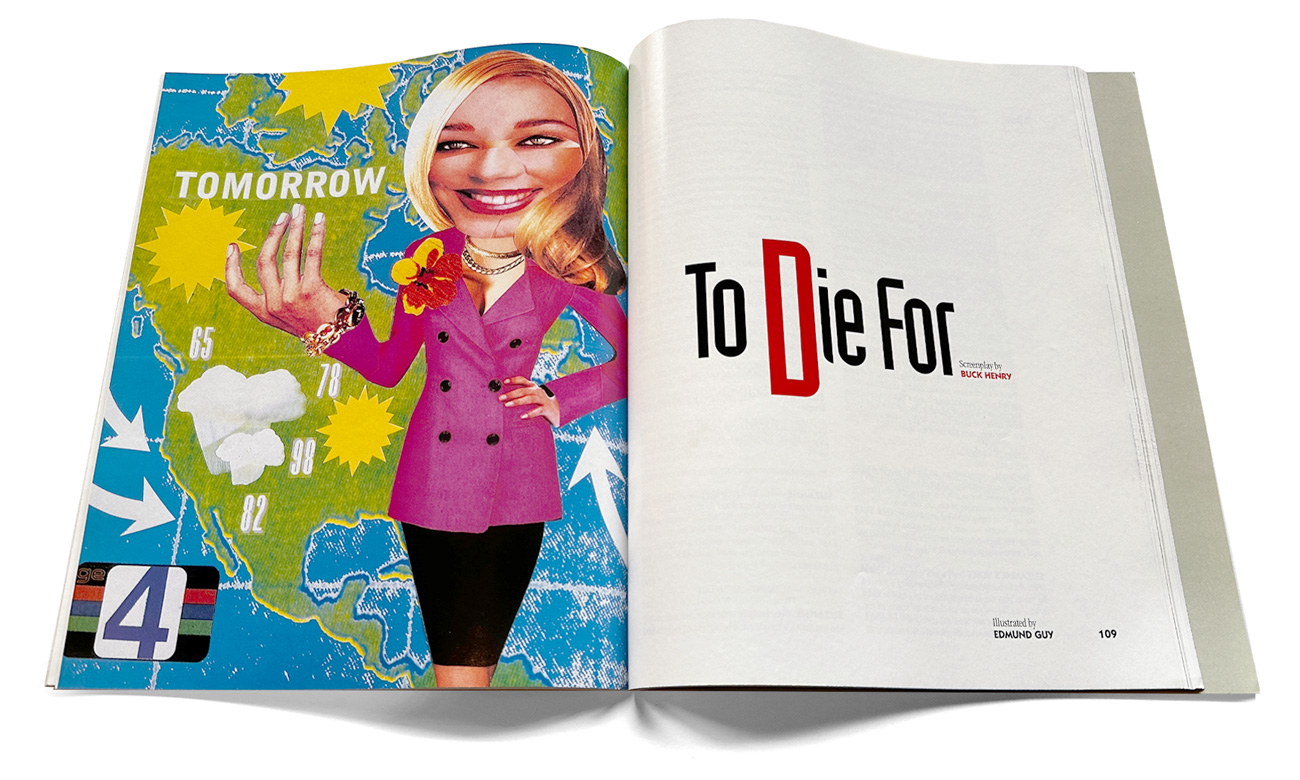
To Die For, adapted by master satirist Buck Henry from Joyce Maynard’s novel (itself loosely based on a 1990 murder case involving a schoolteacher in New Hampshire), treats themes both timeless (ambition, success, betrayal) and contemporary (the omnipresence of the electronic media) in its exploration of main character Suzanne Stone’s ruthless—and strangely innocent—quest for TV fame. Henry’s tight, ingenious structuring of the material presented in this third draft—weaving together videotaped sequences, documentary-like interviews and dramatic segments—was used in the well-regarded film directed by Gus Van Sant, although quite a bit of material featured here was ultimately cut, and, to a certain extent, shifted, in the editing room. Henry discusses the reasons for those changes, as well as his thoughts about losing some of the scenes featured here.
Playwright John Guare (Six Degrees of Separation, House of Blue Leaves) wrote the screenplay for this issue’s final script, Atlantic City, at the behest of its director, Louis Malle. This gentle, quirky rendering of the brief but significant alliance of an aging bookmaker and a blackjack croupier-in-training, set against the atmospheric background of Atlantic City in the early ’80s (soon after gambling had been legalized in this New Jersey seaside resort), netted Guare an Oscar nomination for best screenplay in 1981, as well as awards from the New York, Los Angeles and National Film Critics Circles. Guare discusses the differences between writing for theater and writing for film, and describes his extraordinary working relationship with Malle, who died last year.
The issue begins with a keynote by producer/writer James Schamus (whose credits include The Wedding Banquet, Sense and Sensibility and The Brothers McMullen). His “20 Fragments on the Art of Screenwriting” is filled with provocative, insightful—and inciting—ruminations on the business of writing for film.
You won't find black vans, or black capes, in the work of any of this issue’s contributors; these writers aren't about to let themselves, or their audiences, off so easily. Making the effort to give each character “his or her day in court,” as Sayles puts it in his interview here, involves long hours, often painful self-examination and substantial risk-taking. But the results of this process, which Flannery O’Connor once described as a “terrible plunge into reality,” carry a value that far exceeds and outlasts the opening-weekend receipts of those films whose purpose seems to be to escape that reality on all levels, and at all costs.—Tod Lippy
Related
SCENARIO VOL. 2, NO. 2 CONTENTS
Editor's Note
By Tod Lippy
Keynote Essay: 20 Fragments on the Art of Screenwriting
By James Schamus
Lone Star
Screenplay by John Sayles
Writing & Directing Lone Star
A Talk with John Sayles
Vicky
Screenplay by James Toback
Writing Vicky
A Talk with James Toback
To Die For
Screenplay by Buck Henry
Adapting To Die For
A Talk with Buck Henry
Atlantic City
Screenplay by John Guare
Writing Atlantic City
A Talk with John Guare